
Floor space index diagram
21 December 2023|8 Minutes Read
By : Admin

FSI (Floor Space Index): Its Importance in Building Construction

FSI (Floor Space Index) plays a crucial role in real estate ventures, shaping not just the present but also the future. However, navigating the complex real estate sector can be challenging without a clear understanding of its dynamics. Whether acquiring a new property, planning construction, or purchasing land, it is crucial to adhere to the established rules and regulations.

Understanding real estate terms, concepts, and abbreviations can make the task easier. In this blog, you’ll learn about FSI in real estate, its significance in FSI building construction, how to calculate it using the FSI formula, and more to help you construct with precision. 

What is FSI in Real Estate?

Floor Space Index (FSI), also known as Floor Area Ratio (FAR), is a critical urban planning metric used to regulate the size and density of buildings in a given area. It is defined as the ratio of the total built-up area (floor area) of a building to the size of the plot (land area) on which it is constructed. FSI is expressed as a numerical value or percentage and is determined by local municipal or zoning authorities.

In simple words, FSI meaning refers to a zoning regulation that determines how much construction is allowed on a given plot of land. The FSI full form in construction is a ratio of the total built-up area (floor area) of a building to the size of the plot on which it stands. It is a critical tool used by urban planners and municipal authorities to control the density and intensity of development in a city or region.

Floor Space Index (FSI) in construction

The Floor Space Index (FSI), also known as the Floor Area Ratio (FAR), is a key metric that defines the allowable extent of construction on a specific piece of land. It represents the ratio of the total built-up area to the total land area. FSI plays an essential role in determining the construction density of an area, affecting both the height and scale of buildings.

In simple terms, FSI is a numerical value that reflects the intensity of land use. A higher FSI permits more extensive construction, allowing developers to build larger structures or incorporate additional amenities within a limited land area. Conversely, a lower FSI imposes restrictions on the size of buildings, fostering open spaces and lower-density development.

FSI limits are established by local building regulations and zoning laws to promote balanced and sustainable urban growth. For architects, developers, and urban planners, adhering to these limits is crucial to achieve an optimal balance between efficient land use and a harmonious, functional urban environment. Ultimately, FSI is a vital tool for controlling construction density and shaping the aesthetic and practical qualities of urban areas.

How to Calculate Floor Space Index (FSI)?

Let’s dive into how FSI (Floor Space Index) is calculated. An accurate FSI calculation is crucial for real estate development and construction planning. Using an FSI calculator can help simplify the process. The formula for calculating FSI is:
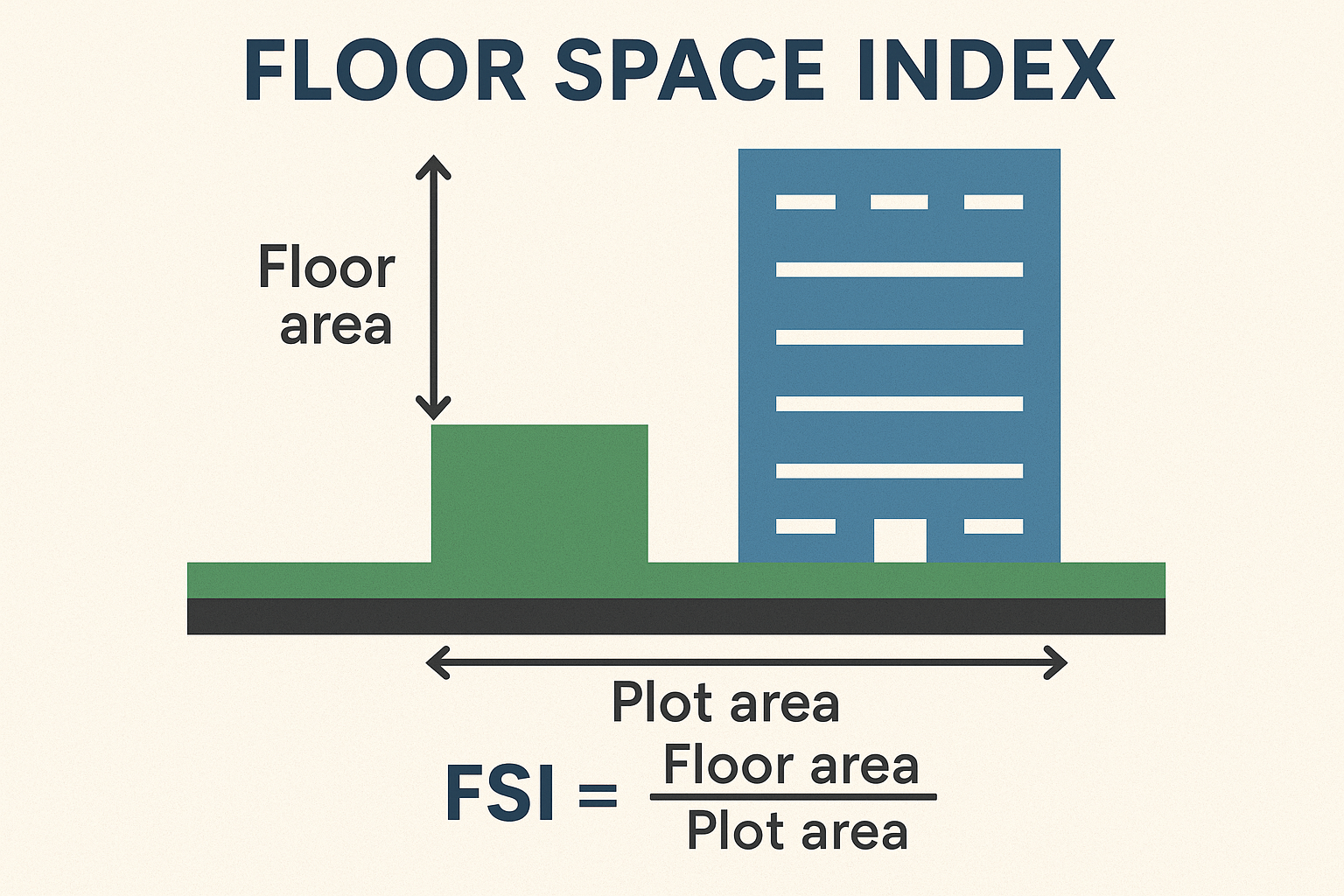
Floor_Space_Index

FSI = Total Built-up Area / Plot Area

For example, imagine a plot with an area of 1,000 sq. ft. The builder plans to construct a residential building on this plot.

The total built-up area for the proposed building is calculated to be 5,000 sq. ft., which includes the area of all floors, such as the ground floor, first floor, second floor, and so on.

To calculate the FSI, we apply the formula:

FSI = Total Built-up Area / Total Plot Area

Here’s how it works:

Total Built-up Area = 5,000 sq. ft. Total Plot Area = 1,000 sq. ft.

Now, plug in these values into the formula:

FSI = 5,000 sq. ft. / 1,000 sq. ft. = 5

Therefore, for a 1,000 sq. ft. plot, the FSI comes out to be 5. This means that the maximum allowable built-up area for this plot is 5,000 sq. ft., based on the FSI calculation in this example. Understanding how to calculate FSI of building using this formula is important for effective FSI calculations in building construction.

FSI Calculation Examples:

Plot Area (sq. ft.)Permissible FSITotal Built-up Area
1,0001.51,500 sq. ft.
2,0002.04,000 sq. ft.
5,0001.26,000 sq. ft.

Use this as a reference to understand how different FSI values affect the construction scope.

Components of Floor Space Index

There are two pivotal components for constructing a building: Basic and Fungible FSI. The summation of these elements dictates the maximum permissible FSI building construction for a given plot.

  • Basic FSI: This segment of FSI is available at no cost, providing a foundational allowance for construction.
  • Fungible FSI: Fungible FSI necessitates purchase from the local authority. It extends beyond the basic FSI and requires payment determined by area rates or the governing authority.

For example, Mumbai allows an additional 35% FSI for residential apartments and 20% for commercial projects, purchasable as Fungible FSI.

Importance of FSI 

The Floor Space Index (FSI) is a key factor in urban planning and real estate development, especially when designing high-rise structures like luxury apartments in Gurgaon, for several important reasons:”
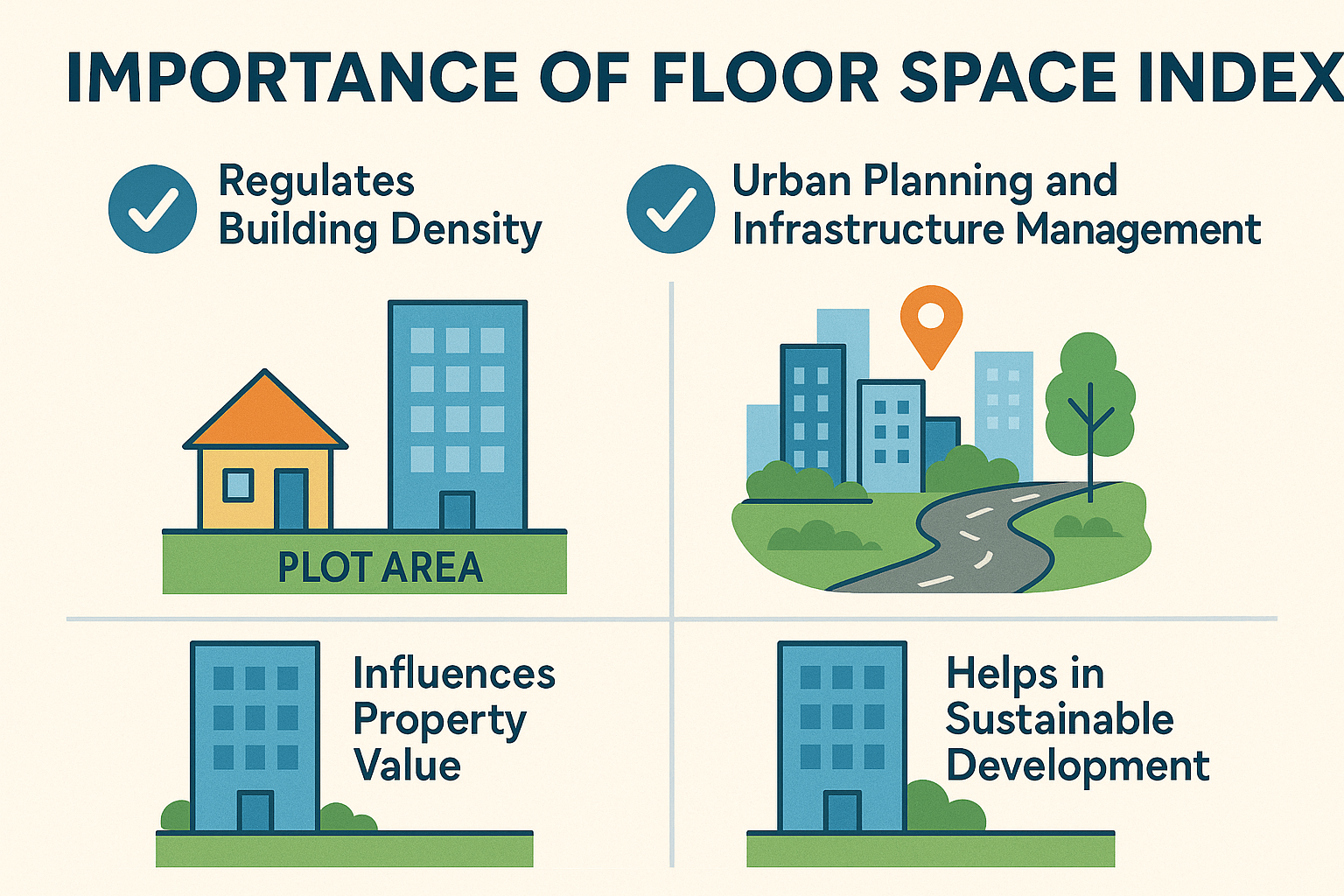
Importance_of_FSI

This version integrates the phrase naturally. Let me know if you need any tweaks!

  • Development Potential: FSI directly affects the potential for development on a plot. A higher FSI allows for more construction, which can result in more units or commercial spaces being built within the same area.
  • Property Valuation: FSI has a direct impact on property values. Plots with higher FSI tend to have a higher market value due to their increased development potential.
  • Infrastructure Planning: FSI is crucial for planning the infrastructure needs of an area. Locations with a higher FSI typically require stronger infrastructure to accommodate the increased population density that comes with more development.
  • Determines Living Space: FSI influences the allowable construction density, which in turn affects the size of individual housing units. For homebuyers, FSI provides an indication of how spacious a home could be, helping them make more informed decisions.
  • Potential for Future Development: Understanding FSI is essential for evaluating future development opportunities in a neighborhood. A higher FSI suggests greater potential for future development, which can be a critical factor when buying property.

Balancing FSI is vital for sustainable development and property market balance.

Benefits of Floor Space Index

FSI offers a range of benefits, and the key ones include: 

  • Preservation of Open Spaces: FSI aids in preserving open areas while facilitating efficient space utilisation in construction projects.
  • Skyline Regulation: It plays an important role in regulating the city skyline, preventing haphazard construction that could disrupt urban landscapes’ aesthetic and functional aspects.
  • Optimised Development Pace: FSI serves as a regulatory mechanism, ensuring projects progress optimally and avoiding rushed or delayed developments that could compromise quality and planning.
  • Strategic Growth Balance: FSI acts as a balancing force, promoting sustained and planned growth. This ensures that urban development aligns with long-term objectives, avoiding erratic spurts that may lead to infrastructural imbalances.

Factors that Influence Floor Space Index 

Several factors significantly influence the maximum floor space index (FSI) allowable for construction projects. The primary determinants encompass:

  • Locality of the Plot: Urban areas near city centres typically boast higher FSIs than distant suburban or outlying areas. The scarcity of open land in city centres contributes to elevated FSIs in these locales.
  • End-Use of the Building: The intended use of the building plays a crucial role. Commercial plots generally enjoy a greater FSI compared to residential ones. For instance, Mumbai sets varying FSIs—3.0 for residential, 4.0 for mass housing, slum rehabilitation, and 5.0 for commercial properties projects.
  • Size of the Plot: Larger plots often entail higher FSIs in many regions. This promotes vertical development, particularly in land-deficient cities.
  • Road Width: FSI regulations are sometimes tied to the width of the road adjacent to the plot. Wider roads typically allow for higher permissible FSIs. For instance, the Municipal Corporation of Greater Mumbai (MCGM) grants a maximum FSI of 3.0 for plots on roads up to 12 meters wide and 4.0 for plots on roads up to 18 meters wide for non-commercial buildings.

Also Read: The Ultimate Guide to Choosing Property Developers in Gurgaon

Conclusion

Building your first home or making a financial investment is a milestone. Real estate entails a substantial, long-term investment, demanding a comprehensive understanding of FSI. If you’re working with a real estate developer in Gurgaon, it’s important to be well-informed about local regulations and construction guidelines. Before committing to a real estate deal, educate yourself at every stage to ensure an informed decision. Guard this crucial purchase with knowledge and precision.

FAQS about Floor Space Index

FSI determines how much space you can build on a piece of land. It plays a key role in planning residential and commercial buildings while keeping cities organized and livable.

Yes. FSI is decided by local municipal and development authorities, and it varies based on location, type of land (residential/commercial), and city infrastructure.

FSI is calculated by dividing the total covered area by the plot area.
For example, if the plot area is 1,000 sq. ft. and the total built-up area is 5,000 sq. ft., the FSI would be:
FSI = 5,000 sq. ft. / 1,000 sq. ft. = 5

The permissible FSI in Gurgaon depends on the zoning regulations and the specific area within the city. For example:

  • In residential areas, the permissible FSI can vary from 1.5 to 2.5 depending on the specific zone.
  • In commercial zones, the permissible FSI can be higher, ranging from 2.5 to 4 or more, depending on local development policies and infrastructure capacity.

It’s essential to check local building and zoning regulations to confirm the exact permissible FSI for a given area in Gurgaon, as it can vary.

The FSI area includes the covered space, while the non-FSI area encompasses the plot’s open spaces.

FSI Area: This refers to the area of the building that contributes to the calculation of the Floor Space Index. It includes the total floor area constructed on all levels of the building, including usable and non-usable spaces like corridors, staircases, and balconies, depending on the local rules.

Non-FSI Area: This refers to areas that do not contribute to the FSI calculation. These can include spaces like:

  • Open spaces like gardens or courtyards
  • Parking spaces (in certain cases)
  • Common amenities that are excluded by local regulations (e.g., swimming pools, basements, etc.)
  • Sometimes, parts of the ground floor or areas set aside for public use might also be excluded from FSI calculations.

The measure of FSI is expressed as a ratio or decimal value. It represents the relationship between the total built-up area and the plot area. For example:

  • An FSI of 1.0 means the total built-up area can be equal to the plot area.
  • An FSI of 2.0 means the total built-up area can be twice the size of the plot area.
  • A higher FSI allows for greater construction on the land.

In summary, FSI measures the density of development on a given plot of land and helps urban planners regulate construction based on available infrastructure and zoning guidelines.

Yes, generally, a higher FSI allows for taller buildings or more floors to be constructed. However, other factors like zoning regulations and building codes also play a part in determining the height of a building.

FSI directly impacts property value, as a higher FSI offers more development potential. Plots with higher FSI are typically valued higher because they allow for more construction, resulting in greater use of the land.

FSI is crucial in planning the necessary infrastructure like roads, sewage, water supply, and utilities. Areas with higher FSI require more robust infrastructure to accommodate the increased population density from larger buildings.

Enquire Now

Recent Posts

Top Reasons Property Investment Beats Fixed Deposits, Gold & Stocks
19 June 2025|7 Minutes Read

Top Reasons Property Investment Beats Fixed Deposits, Gold & Stocks

When it comes to wealth creation in India, the question is no longer whether to invest, but where to invest. For decades, options like Fixed Deposits (FDs), gold, and stock markets have remained go-to choices for the Indian investor. But as we step into 2025, property investment is steadily emerging as the clear winner – and not just for high-net-worth individuals. When it comes to building long-term wealth in India, few investment avenues spark as much debate as property, fixed deposits, gold, and stocks. Each has its loyal followers and unique strengths—but when you weigh in returns, stability, and real-world value, property investment consistently takes the lead. Unlike fixed deposits that often struggle to beat inflation, or gold which doesn’t provide any regular income, or even the volatile stock market that demands active monitoring and nerves of steel, real estate stands out as a reliable, appreciating asset. Whether you're looking for passive income through rent, long-term value appreciation, or simply a tangible investment you can see and touch, property investment in India continues to be one of the most dependable and rewarding choices, especially in 2025 and beyond. Add to that the growing demand for urban housing, the government's push for infrastructure development, and the tax benefits real estate brings—and you have an asset class that not only secures your present but also builds your future. In our blog we shall explore the top reasons why investing in property may just be the smartest financial move you can choose to make. What is Property Investment Property investment refers to the practice of purchasing real estate with the intention of generating income or profit, rather than solely for personal use. This can involve buying properties to rent out, renovate and resell (flipping), or holding them for long-term capital appreciation. Essentially, it's an investment strategy focused on real estate assets as a means to build wealth. Why Property Investment in Gurgaon is a Profitable Decision So, what exactly makes real estate the best investment option in India in 2025? Let's explore the compelling reasons why putting your money in property today could leave traditional investment tools far behind. 1. Stability with Long-Term Growth Fixed Deposits might give you predictable returns, but they rarely beat inflation. Gold, while emotionally significant in Indian households, is largely a hedge, not a growth asset. Stocks? High reward, yes – but equally high risk. Real estate, on the other hand, offers the best of both worlds: long-term appreciation and relative stability. Property values in Tier-1 and Tier-2 cities have seen consistent upward momentum. With growing urbanization, better infrastructure, and rising demand for quality homes, property investment becomes less about speculation and more about future-proofing your wealth. 2. Passive Income through Rentals One of the biggest advantages of property investment in India is that your asset can pay you back. Unlike FDs that lock your money away or gold that just sits in a locker, real estate offers rental yield – a recurring passive income that builds long-term financial freedom. In premium locations, rental yields have been increasing steadily, especially in segments like student housing, co-living spaces, and commercial properties. If chosen wisely, your investment property could become a monthly income stream without you having to lift a finger. 3. Tangible and Emotionally Fulfilling Let’s be honest: there’s a unique sense of pride in owning a piece of land or a home – something that a digital demat account or a gold coin can’t match. Property is tangible. You can see it, live in it, renovate it, rent it, or pass it on to your next generation. In India, emotional security plays a massive role in financial decisions. Real estate fulfills not just financial goals, but also life goals like owning your first home, building a family legacy, or gifting property to your children. 4. Tax Benefits Galore When you compare real estate vs gold vs FDs, the tax benefits offered by property investment give it a clear edge. Home loans bring along deductions under Section 24(b) and Section 80C, helping you reduce your taxable income. Rental income also allows for standard deductions and maintenance exemptions. On the other hand, FDs are taxed at your slab rate, and gold profits attract capital gains tax without the kind of flexible deductions real estate enjoys. 5. Inflation Hedge That Grows With Time Here’s a truth many overlook: property prices typically grow in line with or ahead of inflation. That’s not the case with FDs, which are static in nature and actually diminish in value after adjusting for inflation. Gold does hedge inflation, but its returns can be flat for years. In contrast, real estate tends to gain value as the cost of living rises, and rental income too gets revised over time, offering you an inflation-proof portfolio that grows, not erodes. 6. Leveraging Power – Make More with Less One of the smartest things about investing in property is the ability to leverage. You don’t need the entire capital upfront. With just a 20-25% down payment, banks are willing to fund the rest at interest rates that are historically low. This lets you control a large asset with relatively small capital. Neither gold nor stocks allow this kind of leverage in a safe, structured way, and FDs certainly don’t let you multiply your investment power with borrowed money. 7. Appreciation Potential in Emerging Locations India’s rapid infrastructure development – highways, metro corridors, airports – has opened up a new wave of real estate hotspots. Locations that were once undervalued are now growth magnets. Think Sarjapur in Bangalore, Hinjewadi in Pune, or Dwarka Expressway in Gurgaon. Early investors in these areas have already seen massive returns, and 2025 promises even more opportunities as the government pushes housing, connectivity, and smart city initiatives. Property in these emerging areas remains the best investment option if you’re thinking 5-10 years ahead. 8. Better Risk-Adjusted Returns Stocks can be thrilling, but they’re also volatile and sentiment-driven. One tweet or a global incident can send markets crashing. Gold may be stable, but offers very limited growth. FDs are secure, but unexciting. Property, by contrast, is slow but steady. When you consider rental income, appreciation, tax savings, and capital gain on resale – the overall risk-adjusted returns of real estate often outperform traditional investment assets. It’s about consistent wealth-building, not chasing quick gains. 9. Demand is Not Slowing Down India's growing middle class, millennial homebuyers, NRI investors, and rising dual-income households are fueling demand for quality housing. Add to this the consistent urban migration and government-backed initiatives like PMAY, and it’s clear: demand for property isn't going away. In fact, by 2030, India’s real estate market is projected to reach $1 trillion, with the residential segment being a major driver. Investing in real estate now means riding a long-term wave of upward momentum—especially with future-ready developments like Anantam 85 and Nandaka 84 by Ganga Realty, one of the leading real estate developers in Gurgaon. 10. Emotional Security with Financial Utility Perhaps the most underrated reason: peace of mind. Owning real estate doesn’t just improve your balance sheet, it anchors your life. It gives you security, options during emergencies (you can mortgage or rent), and a sense of control over your financial future. When your FD interest can’t keep up with inflation, your stocks are in red, or gold prices are swinging, a well-located piece of real estate just keeps adding value quietly in the background. Also Read:- Invest in a Luxury Home in Gurgaon Conclusion: Why Property Investment with Ganga Realty Is a Smart Move In the evolving landscape of Indian investments, real estate stands tall—not just as a financial choice, but as a long-term wealth-building strategy. It uniquely combines stability, income generation, and tangible asset appreciation, making it one of the most balanced investment options in 2025. Of course, every investment demands diligence—but when you choose the right partner, the journey becomes significantly more rewarding. That’s where Ganga Realty, a leading real estate company in Gurgaon, comes in. With a track record of delivering premium residential and commercial spaces, Ganga Realty offers trust, transparency, and timeless value. Whether you're planning for your family's future, diversifying your portfolio, or simply looking to hedge against inflation, real estate—especially with a trusted name like Ganga Realty—is more than just a safe bet. It’s a powerful legacy. Invest smart. Invest with confidence. Invest with Ganga Realty. FAQs About Property Investment

Read More
Tax Benefits and Legal Considerations When You Buy Office Space in Gurgaon
19 June 2025|7 Minutes Read

Tax Benefits and Legal Considerations When You Buy Office Space in Gurgaon

Introduction Gurgaon has emerged as one of India's most sought-after business destinations, attracting multinational corporations, startups, and established enterprises alike. The city's strategic location, world-class infrastructure, and business-friendly environment have created unprecedented demand for commercial real estate. As more investors recognize the potential of Gurgaon's commercial sector, the decision to buy office space in Gurgaon has become increasingly attractive, offering both immediate returns and long-term appreciation. The appeal extends beyond just business functionality – investing in commercial office space in Gurgaon presents substantial tax advantages and promising growth prospects. However, navigating the legal landscape and understanding the financial implications requires careful consideration and expert guidance. The Commercial Real Estate Landscape in Gurgaon Gurgaon's transformation from a small town to a global business hub has been remarkable. The city now hosts over 250 Fortune 500 companies, with sectors ranging from information technology and financial services to automotive and pharmaceuticals. This diverse economic base has created sustained demand for premium commercial office space in Gurgaon. The city's commercial real estate market is characterized by several key factors: Infrastructure Excellence : Modern metro connectivity, expressways, and proximity to Indira Gandhi International Airport make Gurgaon highly accessible. The upcoming Dwarka Expressway and other infrastructure projects will further enhance connectivity. Business Ecosystem: The presence of established business districts like Cyber City, Golf Course Road, and Sector 44 creates a thriving ecosystem where businesses can leverage synergies and networking opportunities. Quality Standards: Gurgaon's commercial properties often feature international-grade specifications, including smart building technologies, energy-efficient systems, and premium amenities that attract global tenants. The market dynamics favor investors who buy office space in Gurgaon, with rental yields typically ranging from 6-8% annually, significantly higher than residential properties. The appreciation potential remains strong, driven by limited land availability and growing demand from both domestic and international businesses. Tax Benefits of Investing in Commercial Office Space in Gurgaon Investing in commercial office space in Gurgaon offers several attractive tax benefits that can significantly enhance your overall returns: Depreciation Benefits: Commercial properties are eligible for depreciation allowances under Section 32 of the Income Tax Act. You can claim depreciation on the building structure, furniture, fixtures, and equipment, reducing your taxable income substantially. Interest Deduction: If you've taken a loan to purchase commercial property, the entire interest amount is deductible from your rental income, unlike residential properties where interest deduction is capped at ₹2 lakh annually. Operational Expense Deductions: All legitimate expenses related to property maintenance, repairs, property management, legal fees, and insurance premiums are fully deductible against rental income. Capital Gains Optimization: Long-term capital gains from commercial property sales qualify for indexation benefits, significantly reducing your tax liability. Additionally, you can reinvest proceeds in new commercial properties to defer capital gains tax under Section 54F. Business Loss Adjustment: Losses from commercial property can be adjusted against other income sources, providing additional tax planning flexibility. GST Input Credit: When you buy office space in Gurgaon, you can claim input tax credit on GST paid, which can be offset against your business GST liability. These tax advantages make commercial real estate investment particularly attractive for high-net-worth individuals and businesses looking to optimize their tax planning strategies. Legal Considerations Before You Buy Office Space in Gurgaon The legal framework surrounding commercial real estate in Gurgaon requires careful attention to ensure a secure investment: RERA Compliance: All commercial projects must be registered under the Real Estate (Regulation and Development) Act. Verify the developer's RERA registration and ensure all project approvals are in place before committing to any purchase. Title Verification: Conduct thorough due diligence on the property's title history, including verification of ownership documents, previous transaction records, and any existing encumbrances or legal disputes. Approval Documentation: Ensure the project has obtained all necessary approvals from relevant authorities, including building plans, environmental clearances, fire safety certificates, and occupancy certificates. Lease Agreement Structure: If purchasing for investment purposes, understand the legal framework for commercial leases, including rent escalation clauses, maintenance responsibilities, and tenant rights. Taxation Compliance: Commercial properties are subject to different tax structures compared to residential properties. Understand your obligations regarding property tax, GST on rent, and income tax implications. Insurance Requirements: Commercial properties typically require comprehensive insurance coverage, including public liability, property damage, and business interruption insurance. Working with experienced legal professionals who understand Gurgaon's commercial real estate regulations is essential for navigating these considerations effectively. How Commercial Property Investment Complements Luxury Residential Projects The decision to buy office space in Gurgaon often complements investments in luxury residential projects in Gurgaon and high rise apartments in Gurgaon, creating a diversified real estate portfolio: Risk Diversification: Commercial and residential properties often perform differently during market cycles, providing natural hedge against market volatility. Income Stability: Commercial properties typically offer longer lease terms and more stable rental income compared to residential properties, while luxury residential projects in Gurgaon provide capital appreciation potential. Market Positioning: Investors who own both commercial and residential properties in premium locations like Gurgaon can leverage their market knowledge and relationships for better investment decisions. Tax Optimization: The different tax treatments of commercial and residential properties allow for more sophisticated tax planning strategies. Lifestyle Benefits: Owning both commercial and residential properties in Gurgaon provides the flexibility to live and work in the same city, reducing commute times and enhancing quality of life. High rise apartments in Gurgaon, particularly in areas with good commercial development, often appreciate faster due to the employment opportunities created by nearby office spaces. Why Choose Ganga Realty for Your Next Office Space Investment Ganga Realty has established itself as a trusted name in Gurgaon's real estate market, with a portfolio that spans both commercial and residential developments. Our expertise in commercial office space in Gurgaon is backed by: Strategic Locations: Our commercial projects are situated in prime business districts with excellent connectivity and infrastructure support. Quality Construction: We maintain international standards in construction quality, ensuring your investment appreciates over time and attracts premium tenants. Legal Transparency: All our projects are fully compliant with RERA regulations and local authorities, providing complete peace of mind to investors. Comprehensive Support: From initial investment consultation to post-purchase property management, we provide end-to-end support for our commercial property investors. Market Expertise: With a deep understanding of Gurgaon's commercial real estate market, we help investors make informed decisions that align with their financial goals. Our commitment to excellence extends beyond just property development – we view ourselves as partners in your investment journey, providing ongoing support and market insights to maximize your returns. Conclusion The opportunity to buy office space in Gurgaon represents more than just a real estate investment – it's a strategic move that can provide substantial tax benefits, steady rental income, and long-term capital appreciation. The city's continued growth as a business hub, combined with its robust infrastructure and business-friendly environment, makes commercial office space in Gurgaon an attractive investment proposition. However, success in commercial real estate investment requires careful planning, thorough legal due diligence, and partnership with experienced developers who understand the market dynamics. The tax benefits are substantial, but they must be leveraged correctly to maximize returns while ensuring full compliance with regulatory requirements. Whether you're looking to diversify your portfolio alongside luxury residential projects in Gurgaon and high rise apartments in Gurgaon, or seeking to establish a foothold in commercial real estate, Ganga Realty offers the expertise, quality, and support you need to make informed investment decisions. Ready to explore commercial office space opportunities in Gurgaon? Visit Ganga Realty to discover our premium commercial projects and speak with our investment specialists who can guide you through the tax benefits, legal considerations, and investment opportunities that align with your financial goals. Also Read : The Future of Luxury Living: Indian Real Estate Trends in 2025 Frequently Asked Question

Read More
--> -->